Through my paternity leave and parental leave, I spent what may well remain the most precious memories of my life. And after returning to work, I'm back to busy days once more. Adapting to a work environment transformed so quickly by AI, and trying to shake off the anxiety that I'm falling behind, today too I open the terminal and diligently torment Claude Code and Codex. And in the middle of it, staring blankly at AI's answers and doing nothing but pressing Enter, I felt like a king in a movie or drama who has lost his power, listlessly stamping his seal on the documents his ministers bring him.
A great deal has clearly changed. But does it end simply with adapting to a changed environment? Rather, I've come to wonder what is most important to us right now, and what we should prepare, in order to survive well amid this change.
How a Developer Should Approach AI
The process of returning to the company after about six months of leave began with the commute itself. Greeting colleagues I hadn't seen in a while, and everything up to setting off on the commute home again—it all felt as familiar as if I'd taken a short nap, woken up, and gone back to work. But what felt awkward after returning was the way of entrusting all the edits to AI rather than writing the code myself. There were moments in between when I wondered whether I should write the code by hand, but I recalled a day when we'd joked that a time might come when future developers would say, "Back then you actually typed out the code by hand?!"—looking at us as if at cavemen. I got the feeling that the joke is becoming reality faster than expected.
As I handled a few simple tasks after returning, I grew more and more accustomed to the work processes and to the way of giving commands to AI. Then, while getting a code review from a colleague, I was hit with no small shock. It was that, faced with the code my colleague pointed out, I found myself looking at code I didn't recognize—code I was seeing for the very first time—and I felt that something had gone wrong.
I've seen recent community discussions about the security problems that arise from entrusting work entirely to AI, and about questions of responsibility for what AI produces. And I've had conversations about how a developer who uses AI to build things has to take responsibility for the result, and that this is one of the things AI can't replace a human for. Yet here I was, becoming a person entrusting to AI something I couldn't even take responsibility for, just staring at the terminal and pressing Enter—and that thought snapped me awake.
I've come to wonder what kind of attitude is needed in order to give commands to AI and take responsibility for the code it generates. My immediate thought is that no matter how vast the code AI generates, I should strive to understand all of it, and I should do my own reviews of the results even more thoroughly. And I also thought that perhaps what's needed is a mindset that treats AI not as a tool or a colleague for boosting my work, but as a subordinate carrying out my commands. I can't hurl a report back at AI shouting "Do it again!" like a boss in a drama, but I think what's needed is the attitude of a very, very demanding boss who checks the work meticulously and commands AI precisely so that not merely the best-effort result, but the best result, comes out.
When you go looking for ways to use AI well, most of what you encounter is talk about how to write good prompts, about what form of command yields better results. But rather than accepting the vast output AI pours out exactly as it is, I think the ability to analyze and interpret what's inside it is just as important.
The Role of a Senior Developer in the AI Era
After returning to the company, adapting to the AI-transformed work processes, I've been trying out one by one the AI tools my colleagues built. So much had been automated, and I was impressed by the efforts to improve the work environment not only for developers but for the many collaborating colleagues we work with. About a week passed as I adapted to this changed work environment, but the anxiety and restlessness of having fallen behind didn't easily fade.
Although I don't hold any particular title at the company, I've thought of it as my role, as a senior developer, to set the direction of a project and make it so we can develop while looking toward a single purpose and goal. Yet that thinking had, at some point, turned into an impatience that "I have to do something quickly," and in the end I think it surfaced unnecessarily even in meetings with the colleagues I work with. After one meeting, the words "a leader of an organization must not spread anxiety" suddenly came to mind. I felt like the me of now was a racehorse charging ahead with its eyes blinkered, and I calmed myself by repeating the thought that there's no need to rush.
I'd thought that in an AI era changing so fast, direction had to be set fast too. But during a chapter meeting, I saw that the newly formed FE organization's leadership meeting was planning to raise similar concerns and opinions. In that moment, I was reminded of how I'd been trying to run looking only straight ahead. Perhaps what's needed now isn't to run out ahead of everyone, but to pause, look around, and match strides with the people looking in the same direction.
Getting Ready to Be Replaced by AI
In meetings after returning to work, the idea came up of gradually shifting the various tasks we depend on over to an AI basis. In many places, AI was already handling the markup stage of the design → markup → FE development process, and in a situation short on QA support, there was also discussion of advancing test automation to raise service stability. And rather than stopping at simply proposing ideas and ideating for service improvements, we talked about trying to build service plans and proposals ourselves using AI directly.
At work, so much has become far easier through AI. From generating code based on a task description, to getting reviews and creating GitHub PRs, many things are now handled with just a few keystrokes and an Enter or two. Summarizing work results to write release notes, or analyzing error logs and traffic metrics to find problems, has likewise become far simpler than before.
Among these, the work of producing markup in design → markup → FE—the very task that someone had to do—was completely replaced by AI. An area that a person used to have to take on was now being naturally automated. Amid this change, I've seen articles about how many companies are choosing the direction of cutting headcount. Perhaps that's an unavoidable current created by technological progress.
Recently I saw people, including staff from the company's affiliates, protesting and calling for guaranteed job security. Watching that scene, I suddenly wondered whether there might be people whose work and place are being threatened by AI. And if my own work and place, too, were to be replaced by AI, would the me of that moment be able to calmly accept the situation as an unavoidable current?
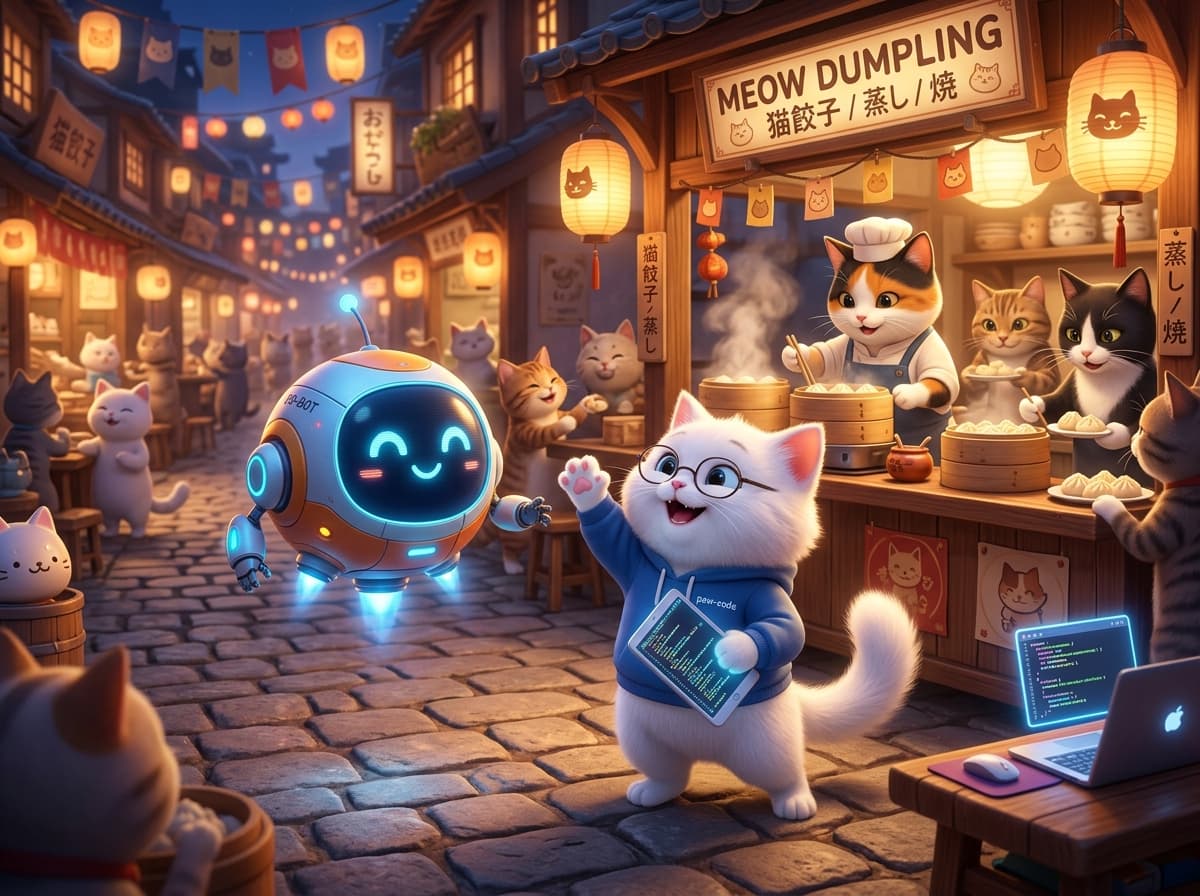
I think about how the work I'm doing now might someday be completely replaced by AI as well. These days I often joke, "If I can't do development work anymore, I'll have to sell dumplings." For now it's a story I can laugh off, but a thought suddenly strikes me. If a day comes when I can no longer tell that joke with a laugh, what should I have been preparing for? The day I come to ponder that question far more seriously than I do now may arrive sooner than I think.
"The future belongs to those who prepare for it today." - Malcolm X -